


Your wallet holds the keys: How myHealth@myHands keeps citizens in charge of their health data
Health data in your hands does not mean health data in your pocket. Your medical history is spread across the doctors, hospitals and pharmacies that have treated you, sometimes in more than one country. The answer is not to copy it all onto your phone. What you need is a way to reach that data when it matters, to decide who else may see it, and to put it to work for you.
That is what the architecture of myHealth@myHands is designed to deliver. It sets out how the project’s core infrastructure fits together: who holds which data, who may ask for it, and how you stay in charge at every step. GNOMON Informatics shaped it, continuing the excellent work of the Centre of Excellence, which introduced the project’s core citizen access infrastructure on this website earlier this year.
Two European building blocks
The architecture brings together two European building blocks. MyHealth@EU already lets doctors and pharmacists in one participating EU country securely access a patient summary or an ePrescription from another. The EU Digital Identity Wallet, which every EU country will offer its citizens, is a secure app for proving who you are and sharing verified information about yourself from your phone. In myHealth@myHands, the two come together so that you can access your own health data, give others access to it, and gain insights from it.
GNOMON knows the first of these well: it has contributed to the development and deployment of OpenNCP, an open-source software that many EU countries use to connect to MyHealth@EU.
Five design choices that keep you in charge
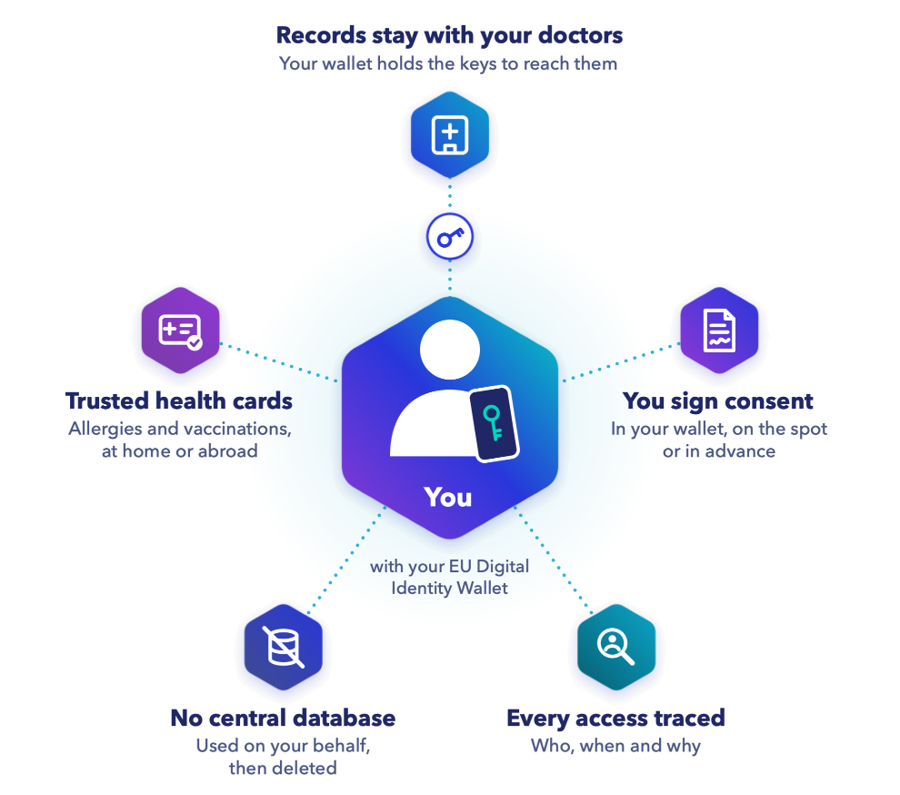
Your records stay where they are. Your health records stay with the doctors and hospitals that created them, and those organisations keep deciding, under their own rules, who may read them. Your wallet does not carry your medical files. It carries signed digital credentials that work like keys: they tell an authorised professional which of your records exist and where to find them.
You give consent by signing it. Before anything is shared, your wallet checks that whoever is asking is registered and trusted, and shows you exactly what they want. If the organisation holding your records asks for consent, you read its privacy policy in your wallet and sign it there, with a qualified electronic signature, which EU law treats as equal to a handwritten one. You can sign on the spot, when a doctor asks to see your records, or in advance. Because each consent builds on the record holder’s own policy, the design works with national laws and local rules instead of replacing them.
Every access leaves a trace. When your records are requested through myHealth@myHands, the request is verified first, and the organisation that holds them can always check who accessed them, when and why.
No new central health database. The project’s core infrastructure is a workhorse, not a warehouse. Acting on your behalf and with your authorisation, it finds your records, fetches and translates them, and runs the services you ask for. It can, for example, pass pseudonymised or anonymised data to smart services, such as decision support tools, and bring the results back to you. When the job is done, your data is deleted from the infrastructure.
Trusted health cards in your wallet. Some information is needed fast. The core infrastructure can pick out your known allergies and vaccinations from your records and issue them to your wallet as signed digital cards, each showing where its information came from. You can show them in an emergency room, at home or abroad, or when a country asks for proof of vaccination at the border.
Your records stay with your doctors. Your wallet holds the keys. You approve each request, and every access leaves a trace.
What it could look like in practice
Imagine you live in Greece and need to see a doctor while visiting Cyprus. Your wallet already holds keys to your records back home, and a signed card listing your allergies.
At the clinic, the doctor’s system asks your wallet for access. Your wallet confirms that the clinic is a registered, trusted requester and shows you what it wants to see. You approve and sign a consent if your hospital at home asks for one. The doctor then retrieves your patient summary from its source in Greece, through MyHealth@EU, and can check your allergy card straight away. Back home, your hospital can see who accessed your record, when and why.
From design to testing
The architecture starts with the six priority categories of health data named in the European Health Data Space regulation, such as patient summaries, ePrescriptions, laboratory results and hospital discharge reports, and is built to take on more, such as care plans, as they become available. It reuses what already works, from MyHealth@EU’s exchange services to the common European formats for health records, rather than inventing new ones.
This autumn, partners across Europe tested its first building blocks, and testing continues in the months ahead.
Health data in your hands, then, is not about carrying your records around. It is about holding the keys, and deciding who may use them.
Author: Maria Sapounaki, GNOMON Informatics SA
Links
myHealth@myHands: https://myhealthmyhands.eu/
CYENS strengthens core citizen access infrastructure in myHealth@myHands: https://myhealthmyhands.eu/2026/02/16/cyens-strengthens-core-citizen-access-infrastructure-in-myhealthmyhands/
MyHealth@EU, European Commission: https://health.ec.europa.eu/ehealth-digital-health-and-care/digital-health-and-care/electronic-cross-border-health-services_en
GNOMON Informatics: https://www.gnomon.com.gr/
Keywords
myHealth@myHands, EU Digital Identity Wallet, MyHealth@EU, European Health Data Space, cross-border healthcare, consent, privacy by design, digital health, GNOMON, CYENS


